
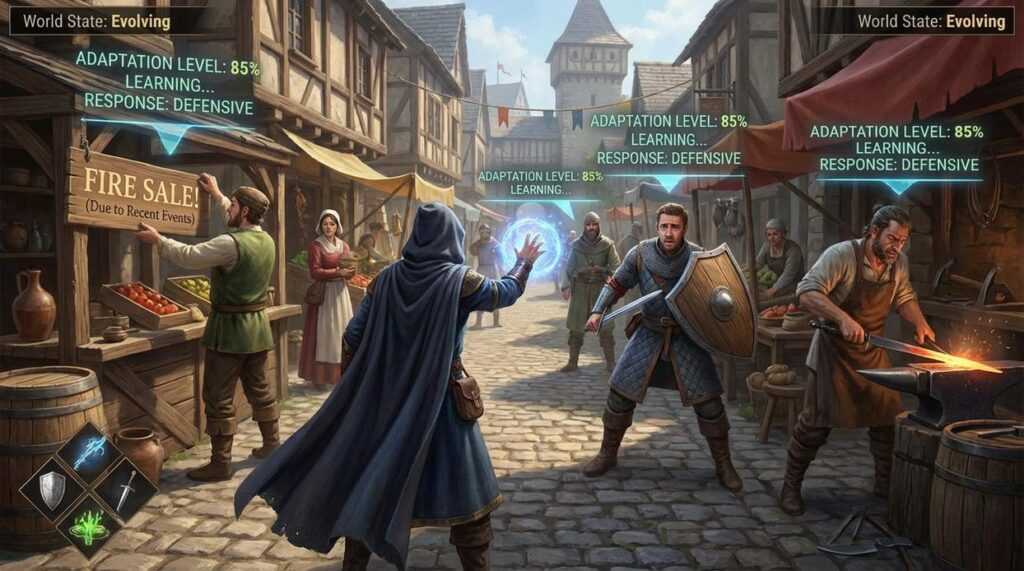
If you’ve been noticing smarter enemies, more lifelike companions, and dynamic worlds that react to your choices, you’re not imagining it. ai npcs in video games are evolving fast—and they’re changing how competitive and casual players approach strategy, immersion, and performance optimization.
This article breaks down what’s actually happening behind the scenes, from core behavioral systems to adaptive difficulty models that influence gameplay outcomes. Whether you’re looking to gain an edge in competitive play, understand emerging esports trends, or simply get more out of your favorite titles, we’ll connect the technical advancements to real in-game impact.
Our analysis draws on current gameplay data, developer insights, and hands-on testing across popular competitive and open-world titles. The goal is simple: cut through the hype and explain what these AI advancements mean for your mechanics, decision-making, and overall gaming experience right now.
Non-player characters, or NPCs, did not start as masterminds. In early arcade and RPG eras, they followed rigid scripts. Take the Pac-Man ghosts: each moved along predefined paths, reacting to player position through simple rules. Likewise, early shopkeepers repeated identical lines no matter what you did. These systems were path-based, meaning movement or dialogue was mapped in advance. Predictable? Absolutely. Intelligent? Not quite.
Next came the illusion of choice. Developers introduced branching dialogue and finite state machines, a system where characters switch between preset “states” like idle, hostile, or friendly based on triggers. This created interactions that felt responsive. For example, picking a rude dialogue option might shift an NPC from calm to angry. However, every outcome was still prewritten.
The real shift arrived with dynamic decision-making. Techniques like:
- Goal-Oriented Action Planning (GOAP), where NPCs evaluate goals and select actions to achieve them.
- Utility AI, which assigns scores to possible actions and chooses the highest value.
Games like F.E.A.R. and The Sims showcased ai npcs in video games making situational choices, coordinating, adapting, and sometimes surprising players. In short, NPCs evolved from predictable puppets into reactive systems that simulate intent rather than merely following scripts with surprising depth.
Crafting Believable Worlds: AI’s Role in Narrative and Immersion
When people talk about immersion, they usually point to graphics. I disagree. Visual fidelity is nice, but it’s behavior that makes a world feel alive. Bethesda’s “Radiant AI” system in Skyrim is a classic example: non-playable characters (NPCs) follow daily schedules, form relationships, eat, sleep, and react to events whether you’re watching or not. That illusion of persistence—where the world seems to continue offscreen—creates what designers call systemic simulation, a rule-based framework that governs character actions dynamically.
Some critics argue these systems are shallow, that routines break immersion once you notice repetition. Fair. You will eventually see patterns. But I’d argue predictability mirrors real life (your barista probably works the same shift every day). The magic is in the overlap of systems, especially with ai npcs in video games interacting unscripted.
Environmental storytelling thrives here. A blacksmith hammering at dawn, a shopkeeper sweeping at dusk, guards whispering about last night’s theft—no exposition required. Rockstar pushed this further in Red Dead Redemption 2, where ambient behaviors subtly reflect town economies and social hierarchies. It’s narrative through observation, not cutscenes.
Emotional resonance is where AI truly shines. In The Last of Us, subtle facial animations, shifting vocal tones, and reactive body language amplify tension. These micro-expressions—tiny muscle movements that signal emotion—are often AI-assisted, blending performance capture with procedural adjustments (Naughty Dog has discussed layered animation systems in developer interviews). That nuance is unforgettable.
Pro tip: when evaluating immersion, watch how characters behave when you do nothing. If the world still breathes, the AI is doing its job.
The Unpredictable Opponent: How Smart NPCs Redefine Gameplay

Dynamic Difficulty Scaling is the design approach where a game adjusts its challenge in real time based on player performance. If you’re steamrolling enemies, the AI becomes more aggressive, coordinates flanks, or uses advanced abilities. Struggling? It may ease off slightly, giving you room to recover. Resident Evil 4 famously adjusted enemy pressure behind the scenes, keeping tension high without feeling unfair (Capcom developer interviews, 2005).
Practical tip: If you notice enemies suddenly coordinating or countering your favorite move, switch tactics immediately. Rotate weapons, vary positioning, and test whether the AI adapts again. Treat it like sparring, not button-mashing.
In competitive modes, smarter bots reshape training. Many esports titles now use advanced practice AI that mimics human timing and map control. This forces you to develop strategies that hold up against unpredictability. For example:
- Practice crossfire setups that work even if a bot peeks at odd timings.
- Run scrims where one teammate plays “AI style,” prioritizing objective logic over ego duels.
The result? Tactics that translate better to ranked play.
Then there’s emergent gameplay—unscripted moments born from complex systems colliding. In S.T.A.L.K.E.R., roaming factions fight independently, sometimes saving (or ambushing) you without warning. Physics engines add chaos: a stray grenade shifts cover, changing the entire firefight. These layered systems make ai npcs in video games feel less like scripted actors and more like rival players.
Some argue smarter AI can feel “cheap” or immersion-breaking. Fair point. Poor tuning leads to rubber-banding or omniscience. But when balanced carefully, adaptive AI creates replayable tension—like facing a chess opponent who actually studies your openings.
For more perspective on platform performance differences, see cloud gaming vs console gaming what players need to know.
The Next Frontier: Generative AI and Procedural Characters
Generative AI is pushing games beyond scripted dialogue trees into Infinite Dialogue—conversations powered by Large Language Models (LLMs), meaning AI systems trained on massive text datasets to predict and generate human-like responses. Instead of choosing from four preset lines, players can type or speak anything and receive context-aware replies. Think less “Press X to ask about rumors,” more actually interrogating a suspect like you’re in a crime drama.
Practical example: developers can anchor an LLM with:
- A defined character profile (age, faction, moral code)
- World lore constraints
- Memory logs of prior player interactions
This keeps responses immersive rather than chaotic. (Yes, nobody wants a medieval knight referencing Wi‑Fi.)
Then there’s Procedurally Generated Personalities—AI-built characters created on the fly with unique backstories, motivations, and even questlines. In ai npcs in video games, this could mean every tavern visit introduces someone genuinely new. Replayability skyrockets because no two playthroughs unfold the same way.
But challenges remain:
- Narrative consistency across long campaigns
- Computational load for real-time generation
- Brand safety and content moderation
Pro tip: Start small. Prototype AI-driven side characters before making them central to the main storyline. Controlled sandboxes reduce risk while refining performance and tone.
Level Up Your Edge with Smarter NPC Strategy
You came here to better understand how ai npcs in video games are reshaping gameplay, competitive balance, and player strategy—and now you’ve seen exactly how they influence mechanics, decision-making, and overall match outcomes.
The reality is this: if you’re not adapting to smarter NPC behavior, you’re already at a disadvantage. Whether it’s reading adaptive patterns, countering machine-learned tactics, or optimizing your loadout to exploit AI limitations, the players who study the system are the ones who dominate the leaderboard.
Now it’s your move.
Start analyzing NPC behavior in your next sessions. Break down their pathing, reaction timing, and scaling mechanics. Test counter-strategies. Refine your build. The edge comes from intentional practice—not guesswork.
If you’re serious about gaining a competitive advantage, dive deeper into advanced strategy breakdowns and gear optimization insights trusted by thousands of competitive players. Don’t just play the game—outsmart it.
Your opponents are adapting. Make sure you are too.
 Pagesticany Johnson writes the kind of core gaming concepts and mechanics content that people actually send to each other. Not because it's flashy or controversial, but because it's the sort of thing where you read it and immediately think of three people who need to see it. Pagesticany has a talent for identifying the questions that a lot of people have but haven't quite figured out how to articulate yet — and then answering them properly.
They covers a lot of ground: Core Gaming Concepts and Mechanics, Esports and Multiplayer Trends, Expert Insights, and plenty of adjacent territory that doesn't always get treated with the same seriousness. The consistency across all of it is a certain kind of respect for the reader. Pagesticany doesn't assume people are stupid, and they doesn't assume they know everything either. They writes for someone who is genuinely trying to figure something out — because that's usually who's actually reading. That assumption shapes everything from how they structures an explanation to how much background they includes before getting to the point.
Beyond the practical stuff, there's something in Pagesticany's writing that reflects a real investment in the subject — not performed enthusiasm, but the kind of sustained interest that produces insight over time. They has been paying attention to core gaming concepts and mechanics long enough that they notices things a more casual observer would miss. That depth shows up in the work in ways that are hard to fake.
Pagesticany Johnson writes the kind of core gaming concepts and mechanics content that people actually send to each other. Not because it's flashy or controversial, but because it's the sort of thing where you read it and immediately think of three people who need to see it. Pagesticany has a talent for identifying the questions that a lot of people have but haven't quite figured out how to articulate yet — and then answering them properly.
They covers a lot of ground: Core Gaming Concepts and Mechanics, Esports and Multiplayer Trends, Expert Insights, and plenty of adjacent territory that doesn't always get treated with the same seriousness. The consistency across all of it is a certain kind of respect for the reader. Pagesticany doesn't assume people are stupid, and they doesn't assume they know everything either. They writes for someone who is genuinely trying to figure something out — because that's usually who's actually reading. That assumption shapes everything from how they structures an explanation to how much background they includes before getting to the point.
Beyond the practical stuff, there's something in Pagesticany's writing that reflects a real investment in the subject — not performed enthusiasm, but the kind of sustained interest that produces insight over time. They has been paying attention to core gaming concepts and mechanics long enough that they notices things a more casual observer would miss. That depth shows up in the work in ways that are hard to fake.